
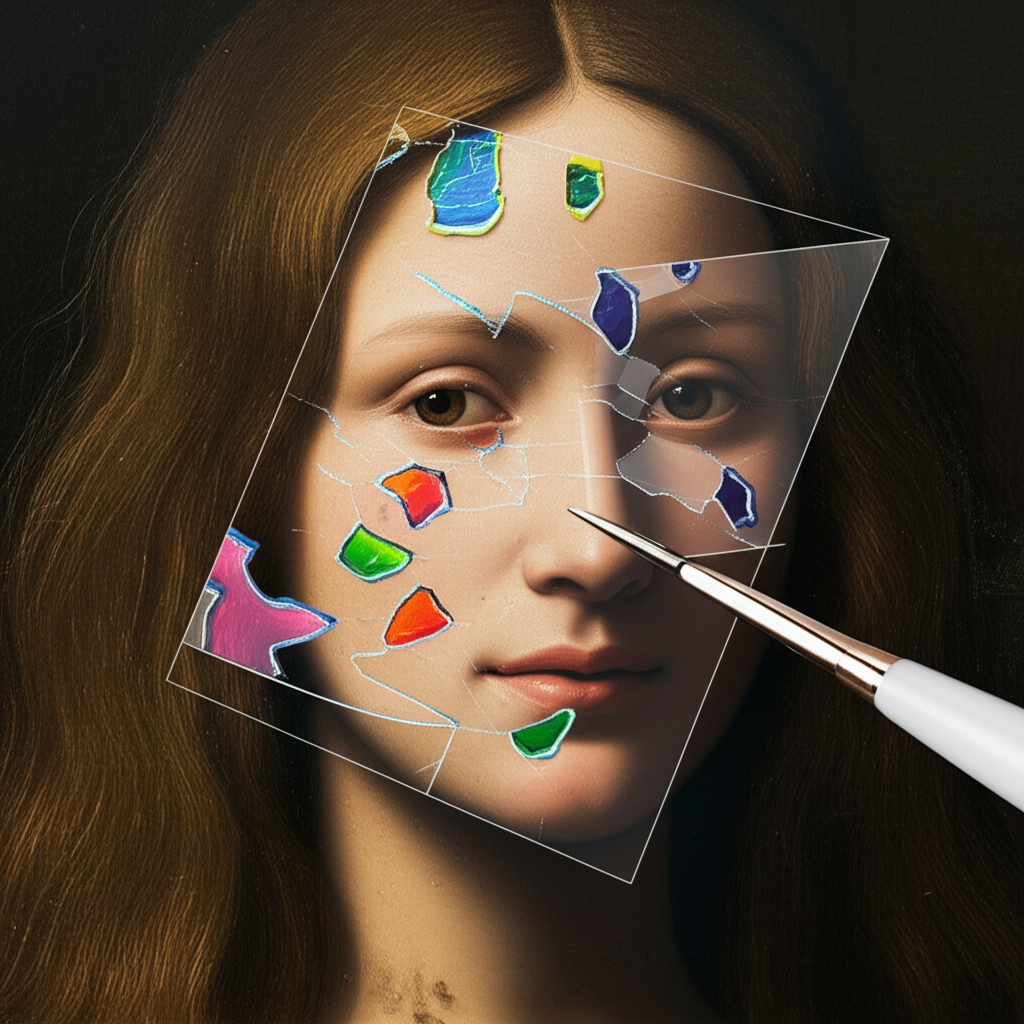
AI-Powered “Mask” Restores Damaged Paintings in Hours
Art restoration, a meticulous craft demanding skilled hands and a keen eye, has traditionally been a time-intensive endeavor. For centuries, conservators have painstakingly revived paintings, identifying areas needing repair and precisely matching shades to fill in each tiny region. The sheer number of these regions, often numbering in the thousands, meant that restoring a single painting could span weeks, months, or even over a decade.
The advent of digital restoration tools offered a promising alternative, creating virtual representations of original, restored artworks. These tools leverage computer vision, image recognition, and color matching to rapidly generate “digitally restored” versions of paintings. However, a significant gap remained: translating these digital restorations directly onto an original work – until now.
Alex Kachkine, a mechanical engineering graduate student at MIT, introduces a groundbreaking method to physically apply digital restorations directly onto original paintings. His research, published in the journal Nature, details a process where the restoration is printed onto a thin polymer film, forming a mask that can be aligned and adhered to the original painting, and easily removed. This innovative approach promises to revolutionize art conservation.
According to Kachkine, the digital file of the mask acts as a precise record of the restoration, allowing future conservators to understand exactly what changes were made. “Because there’s a digital record of what mask was used, in 100 years, the next time someone is working with this, they’ll have an extremely clear understanding of what was done to the painting,” Kachkine explains. “And that’s never really been possible in conservation before.”
In a demonstration, Kachkine applied his method to a badly damaged 15th-century oil painting. The system automatically identified 5,612 regions needing repair and filled them using 57,314 different colors. The entire process, from start to finish, took only 3.5 hours – an estimated 66 times faster than traditional restoration methods.
Acknowledging the ethical considerations inherent in any restoration project, Kachkine emphasizes the importance of consulting with conservators knowledgeable in a painting’s history and origins. The goal is to ensure that any restored version appropriately represents the artist’s original style and intent.
“There is a lot of damaged art in storage that might never be seen,” Kachkine says. “Hopefully with this new method, there’s a chance we’ll see more art, which I would be delighted by.”
Kachkine’s journey began with visits to art galleries, where he realized that displayed art represents only a fraction of galleries’ holdings. Much of the art remains in storage due to age or damage, awaiting lengthy restoration. He has learned that digital tools can speed up the restoration process significantly. AI algorithms quickly analyze vast amounts of visual data, learning connections to generate digitally restored versions resembling the artist’s style or period.
However, these digital restorations are usually displayed virtually or printed as stand-alone works, unable to directly retouch original art. Kachkine’s method bridges this gap by physically applying a digital restoration onto an original painting.
The new method involves cleaning the painting and removing past restoration attempts. The cleaned painting is then scanned to identify areas with faded or cracked paint. AI algorithms analyze the scan to create a virtual version of the painting’s original state.
Software developed by Kachkine maps regions needing infilling and the exact colors required to match the digitally restored version. This map is translated into a two-layer mask printed onto thin polymer films. The first layer is printed in color, and the second layer is printed in the same pattern in white. This ensures full color reproduction. The mask layers are carefully aligned and overlaid onto the original painting, adhered with a thin spray of conventional varnish. The printed films can be easily dissolved with conservation-grade solutions if the original, damaged work needs to be revealed. The digital file of the mask serves as a detailed record of the restoration.
Kachkine estimates that his new method can be orders of magnitude faster than traditional approaches. He emphasizes that conservators should be involved at every step to ensure the final work aligns with the artist’s style and intent.