
Ford Revolutionizes EV Manufacturing: Ditching Henry Ford’s Assembly Line for Affordable American EVs
Ford is making a monumental shift in its manufacturing strategy, investing $2 billion to transform its Louisville Assembly Plant into a hub for next-generation affordable electric vehicles. This ambitious project, slated to begin production in 2027 with a mid-sized pickup truck priced around $30,000, marks a radical departure from the automotive industry’s foundational assembly line system, pioneered by Henry Ford himself over 112 years ago.
The automaker’s willingness to overhaul its iconic assembly line underscores the high stakes involved in producing affordable EVs in America. The goal is to achieve greater speed, efficiency, and fewer parts, all while ensuring profitability and enabling Ford to better compete with global manufacturers, particularly those in China. Doug Field, Ford’s Chief EV, Digital, and Design Officer, highlighted that this isn’t just about cost reduction but a strategic move for long-term competitiveness.
Ford CEO Jim Farley has described the initiative, including the new production system and the $2 billion investment, as a significant “bet.” Speaking from the Kentucky plant, Farley acknowledged the inherent risks, stating, “There are no guarantees with this project. We’re doing so many new things I can’t tell you with 100% certainty that this will all go just right.” This bold gamble comes as Ford’s EV division grappled with a reported loss of around $1.3 billion in the second quarter of 2025, and sales for its popular F-150 Lightning and Mustang Mach-E models have been declining.
The foundation for this transformation was laid several years ago by a dedicated “skunkworks” team of approximately 500 individuals. This elite group, comprised of talent poached from companies like Tesla, Rivian, Apple, and Lucid Motors, and led by former Tesla executive Alan Clarke, was tasked with developing the innovative production system and the underlying vehicle platform. The team operates from offices in Palo Alto and a new location in Long Beach, California.
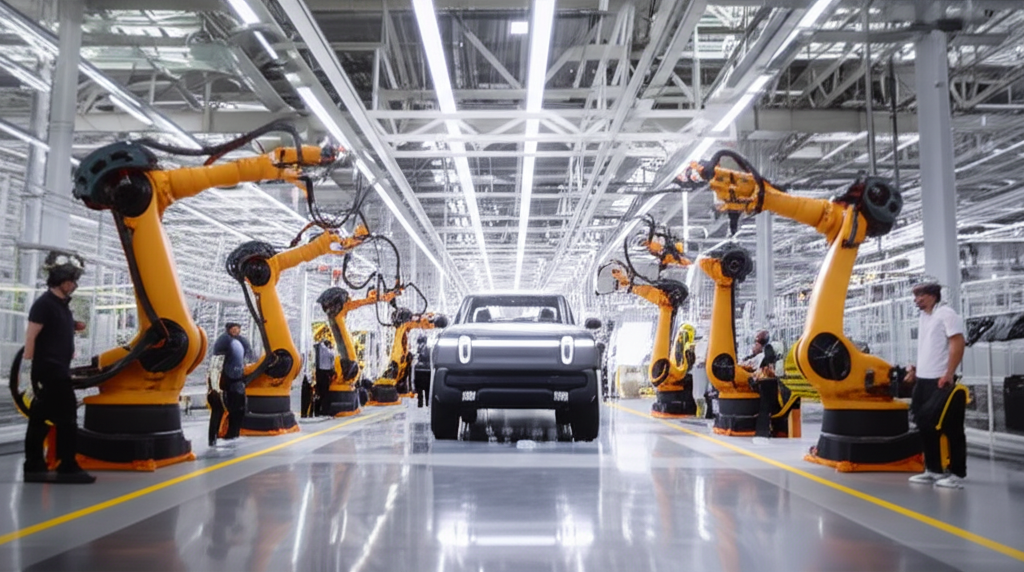
The result of this R&D effort is what Ford terms the “universal production system.” This revolutionary approach replaces the traditional single moving conveyor belt with a three-branched assembly tree. This system is designed to significantly reduce the number of parts required – by 20% overall, including a 50% reduction in cooling hoses and connections, and 25% fewer fasteners. Production is also expected to be 15% faster.
Central to this new system is a universal EV platform designed for simplicity and modularity. It will utilize lithium iron phosphate (LFP) batteries, leveraging technology licensed from China’s CATL. These batteries will be manufactured at Ford’s new $3 billion BlueOval Battery Park facility in Michigan, which is scheduled to commence operations in 2026 and will employ 1,700 workers. The platform itself features large, single-piece aluminum unicastings, simplifying assembly. The front and rear sections of the vehicle can be built independently on two of the branches, while the third branch is dedicated to integrating the structural battery with seats, consoles, and carpeting. These three major components converge at the end of the line to form the complete vehicle.
The first vehicle to roll off the redesigned line will be a mid-sized pickup truck. While approximately the same exterior size as the Ford Maverick, it is designed to offer a roomier interior. The new production process also streamlines operations by providing workers with kits containing all necessary fasteners and tools, precisely oriented for each task, reducing the need for parts docking stations by 40%.

Alan Clarke, speaking about the innovation, noted that the system is unlike anything publicly documented. “I think that a manufacturing expert would look at this, and especially if they’ve been in the automotive industry for a few decades, would sort of scoff at it and say, ‘why would you do it this way?’” he admitted. However, Clarke is confident that once the efficiency gains are demonstrated, other manufacturers will follow suit.
This transformation will impact the workforce at the Louisville plant, reducing the number of hourly employees from approximately 2,808 to 2,200 – a reduction of 600 workers. Ford is offering special retirement incentives and intends to provide roles at other facilities for any workers who do not take the early retirement option. Importantly, Ford has maintained close collaboration with the United Auto Workers (UAW) throughout the planning process, securing union buy-in. UAW representatives have expressed support, emphasizing that the new system improves worker ergonomics and safety, allowing employees to go home less fatigued.
“The teams are really excited about what’s coming because they know that we have to be competitive and we have to make money from this project for jobs to stay in America,” Clarke commented. Brandon Reisinger, UAW chairperson at the Louisville plant, added, “Ergonomics has been taken into it a whole lot more. We should have a healthier workforce. Should be able to go home to your families and not be sore at the end of the day, which is going to be great.”
The current production of the Ford Escape and Lincoln Corsair at the Louisville plant will continue until the end of this year, after which the factory will undergo retooling for the new EV family. This strategic overhaul is Ford’s decisive move to redefine automotive manufacturing for the electric era, aiming to build affordable EVs efficiently and competitively within the United States.