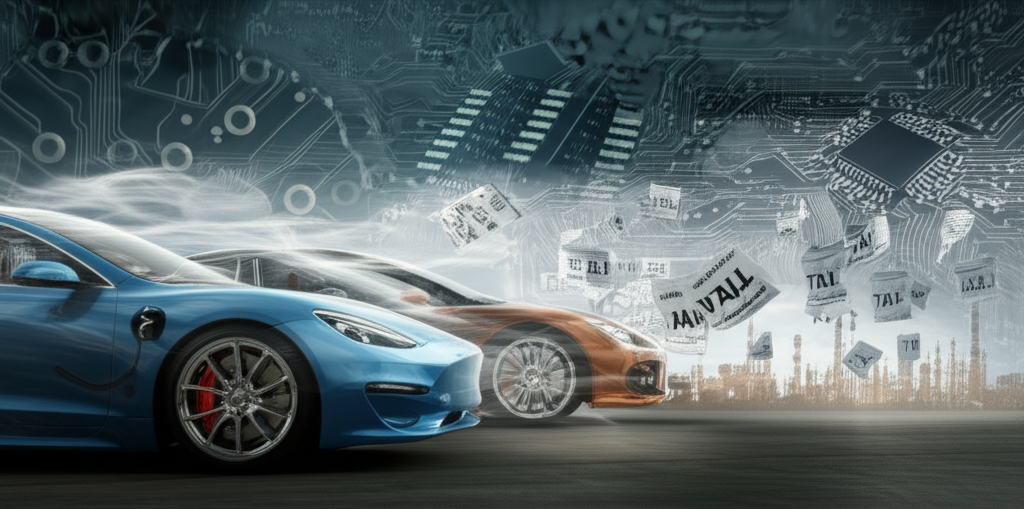
TechCrunch Mobility: The Triple Punch Headed for Automakers
Welcome back to TechCrunch Mobility – your dedicated source for the latest in transportation. This week, we delve into the significant economic pressures facing electric vehicle (EV) manufacturers and legacy automakers alike.
Automakers such as Rivian and Lucid, alongside established players like Ford and GM, are closely monitoring the impact of new tariffs and the winding down of federal EV tax credits. These economic shifts, detailed in recent 10Q reports, are clearly a primary concern for their executive teams.
Both Rivian and Lucid have made explicit mentions of the One Big Beautiful Bill Act (OBBBA) within their risk factor disclosures. The OBBBA not only eliminates certain tax credits for EV buyers but also devalues the market for zero-emissions regulatory credits. Tariffs and trade policy risks are also frequently cited.
Lucid, in its latest filing, states it is assessing the OBBBA’s impact, acknowledging that supplier disruptions due to financial distress could affect production and quality requirements. Rivian, meanwhile, adopts a more optimistic stance, highlighting the continued availability of the 45X tax credit for domestic battery production.
Ford and GM also reference the OBBBA, though they place greater emphasis on the potential ramifications of tariffs. GM notes that while the financial impact of the OBBBA is currently unquantifiable, it “could be material and may adversely affect electric vehicle profitability.”
Adding to these challenges is the looming threat of a potential 100% import tariff on semiconductor chips. This development could severely squeeze the industry, recalling the critical chip shortages experienced during the COVID-19 pandemic that crippled automotive production. Modern vehicles rely heavily on semiconductors, often containing over a thousand chips, making supply chain stability paramount.
Automakers are watching closely to see how exemptions for domestically manufactured chips might be awarded. Given that automakers are not typically chip manufacturers, a strong reliance on domestic suppliers may become necessary. However, the administration’s history of policy shifts means details on these tariffs and exemption processes remain uncertain.
The resulting uncertainty casts a shadow over the industry, impacting strategic planning and investment.
Shifting Sands: Chinese Companies and US Markets
Amidst trade tensions, there are whispers within the industry of Chinese companies, particularly those focused on autonomous vehicle technology and related sectors, repatriating operations back to the United States. This trend warrants further investigation as it could reshape the competitive landscape.
Key Acquisitions and Funding Rounds
Joby Aviation is set to acquire Blade Air Mobility’s ride-share business for up to $125 million. This deal includes the Blade brand and its passenger operations in the U.S. and Europe, excluding its medical division. The acquisition provides Joby with crucial infrastructure for scaling its electric air-taxi services.
Drone startup Destinus, which supplies to Ukraine, plans to acquire Swiss autopilot systems developer Daedalean for an estimated $223 million in cash and stock.
Jeh Aerospace, an Indian aerospace component manufacturer based in Atlanta, has secured $11 million in a Series A funding round led by Elevation Capital, with participation from General Catalyst.
Uzbekistan-based express delivery and fintech startup Uzum raised $65.5 million, co-led by Tencent and VR Capital, with U.S.-based FinSight Ventures also participating.
Industry News and Developments
Foxconn has sold its former GM factory in Ohio for $88 million and its EV subsidiary assets for approximately $287 million. The buyer, reportedly SoftBank, plans to convert the facility into an AI data center, marking an end to Foxconn’s efforts to scale EV production at the site.
Lyft is partnering with Chinese tech giant Baidu to deploy Apollo Go autonomous vehicles in several European markets, with plans to launch robotaxi services in Germany and the United Kingdom in 2026.
Rivian has initiated a lawsuit in Ohio, challenging the state’s direct-to-consumer sales laws, which the company argues unfairly benefit Tesla.
A significant report from The New York Times details Uber’s ongoing struggles with sexual assault issues.
Zoox has received an exemption from federal safety regulators to test its custom-built robotaxis on public roads, resolving previous discussions regarding compliance with federal motor vehicle safety standards.
In a notable turn of events, Tesla’s board approved a substantial $29 billion share-based compensation package for CEO Elon Musk, citing an intensifying AI talent war. Concurrently, the company is facing headwinds, including the shuttering of its Dojo supercomputer program, intended for in-house driverless technology development, and a jury verdict finding Tesla partially liable for a fatal 2019 crash, awarding $242.5 million in damages. The case highlighted concerns about the discrepancy between Tesla’s portrayal of its Autopilot system and its actual capabilities.
Podcast Highlight
On a recent episode of The Autonocast, a podcast co-hosted by our team, Boris Sofman, former head of Waymo’s self-driving trucks program and co-founder of Anki Robotics, discussed his new autonomous vehicle technology startup, Bedrock Robotics.
The current automotive landscape is defined by uncertainty, with multiple external factors testing the resilience and adaptability of manufacturers worldwide.