Top 10 Latest AI Agents of 2025 and Their Basic Architecture
Top 10 Latest AI Agents of 2025 and Their Basic Architecture (and How to Use Them)
The AI Revolution: Why AI Agents Are Reshaping the Digital World
Imagine a world where your business runs itself while you sleep. Your customer inquiries are answered instantly, leads are generated automatically, and your marketing campaigns are optimized in real-time—all without lifting a finger. This isn’t science fiction; it’s the reality of AI agents in 2025.
These aren’t your average chatbots. AI agents are autonomous systems that think, act, and build. They’re designed to handle complex workflows, make decisions, and even collaborate with other agents to achieve goals. From startups to Fortune 500 companies, businesses are leveraging these agents to automate tasks, boost productivity, and stay ahead in a rapidly evolving tech landscape.
In this blog, we’ll explore 10 of the most powerful AI agents of 2025, break down their basic architecture, and show you how to use them to transform your workflows. Whether you’re an AI enthusiast, a startup founder, or a marketer, this guide will help you unlock the full potential of AI automation.
What Are AI Agents? (Explained Simply)
At their core, AI agents are software programs designed to perform tasks autonomously. Unlike traditional chatbots, which rely on pre-programmed responses, AI agents are goal-driven systems capable of reasoning, learning, and adapting to new information.
Core Components of AI Agents
- LLMs (Large Language Models): The “brain” of the agent, responsible for decision-making and reasoning.
- Memory: Enables the agent to store and recall information, both short-term (for immediate tasks) and long-term (for learning over time).
- Tools/Plugins: Extend the agent’s capabilities, such as browsing the web, coding, or sending emails.
- Environment: The context in which the agent operates, including APIs, databases, and user inputs.
- Goal-Driven Architecture: Ensures the agent stays focused on achieving specific objectives.
AI Agents vs. Chatbots
While chatbots are limited to answering questions or following scripts, AI agents are dynamic and proactive. They can:
- Plan and execute multi-step tasks.
- Collaborate with other agents.
- Continuously improve through feedback loops.
Think of an AI agent as an employee with a brain (LLM), a notebook (memory), and access to the internet (tools/plugins).
Basic Architecture of AI Agents
To understand how AI agents work, let’s break down their architecture into simple layers:
1. LLM (The Brain)
The Large Language Model is the decision-making layer. It processes inputs, generates responses, and plans actions. Popular LLMs include OpenAI’s GPT-4, Anthropic’s Claude, and Google’s Gemini.
2. Memory
- Short-Term Memory: Stores information temporarily for immediate tasks.
- Long-Term Memory: Retains knowledge over time, allowing the agent to learn and adapt.
3. Tools and Plugins
These are the “hands” of the agent, enabling it to perform actions like:
- Browsing the web.
- Writing code.
- Sending emails.
- Accessing APIs.
4. Planning and Execution
This layer ensures the agent can break down complex tasks into smaller steps and execute them in sequence.
5. Feedback Loop
The agent evaluates its performance, learns from mistakes, and improves over time. This self-improvement mechanism is what makes AI agents so powerful.
Analogy: The AI Employee
Imagine an AI agent as an employee:
- Brain: Thinks and makes decisions.
- Notebook: Keeps track of tasks and learns from experience.
- Tools: Uses software and resources to get the job done.
Top 10 Latest AI Agents of 2025
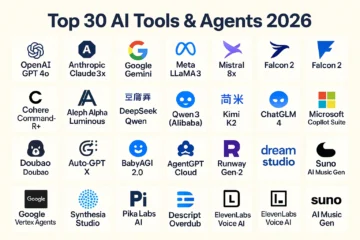
Here’s a curated list of the most innovative AI agents of 2025, their architecture, and how to use them.
1. OpenAI GPT-5
- Overview: The next-gen enterprise AI agent platform, ideal for customer service and automation.
- Key Features: Advanced reasoning, multi-modal capabilities, and real-time adaptability.
- Architecture: Built on OpenAI’s proprietary LLM framework with integrated memory and tools.
- How to Use: Deploy GPT-5 for customer support, lead generation, or content creation. Simply integrate it with your CRM or website.
- Use Case: Automate customer inquiries and reduce response times by 70%.
2. Google DeepMind Agents
- Overview: AI agents tailored for healthcare and research.
- Key Features: High accuracy, ethical decision-making, and data security.
- Architecture: Combines LLMs with specialized healthcare datasets.
- How to Use: Integrate with medical databases to assist in diagnostics or research.
- Use Case: Streamline patient data analysis for faster diagnoses.
3. Anthropic Claude
- Overview: A safe and ethical AI agent for enterprise use.
- Key Features: Transparency, reliability, and compliance with ethical standards.
- Architecture: Built on Anthropic’s Claude framework with robust safety layers.
- How to Use: Use Claude for sensitive tasks like legal document analysis or HR workflows.
- Use Case: Automate contract reviews while ensuring compliance.
4. INFOFLA’s Vision-Based AI Agent “Selto”
- Overview: Specializes in vision-based tasks and automation.
- Key Features: Image recognition, object detection, and real-time analysis.
- Architecture: Combines vision models with RAG (Retrieval-Augmented Generation).
- How to Use: Deploy Selto for quality control in manufacturing or visual data analysis.
- Use Case: Automate defect detection in production lines.
5. AgentGPT
- Overview: A no-code platform for building custom AI agents.
- Key Features: Drag-and-drop interface, multi-agent collaboration, and API integration.
- Architecture: Built on LangChain with modular components.
- How to Use: Create agents for specific tasks like scheduling or data extraction.
- Use Case: Automate meeting scheduling across multiple time zones.
6. Teneo AI Agents
- Overview: Conversational AI agents for enterprise applications.
- Key Features: Multi-language support, contextual understanding, and scalability.
- Architecture: Combines LLMs with proprietary conversational frameworks.
- How to Use: Deploy Teneo agents for customer support or employee training.
- Use Case: Enhance employee onboarding with interactive training modules.
7. Marketing AI Agents
- Overview: Automates marketing tasks like lead generation and campaign management.
- Key Features: Personalization, analytics, and multi-channel deployment.
- Architecture: Uses RAG and LLMs for data-driven decision-making.
- How to Use: Integrate with your CRM to automate email campaigns and track performance.
- Use Case: Boost lead conversion rates by 50%.
8. Everyday Task Agents
- Overview: Simplifies daily tasks like scheduling and reminders.
- Key Features: Natural language understanding and real-time adaptability.
- Architecture: Built on lightweight LLMs with minimal resource requirements.
- How to Use: Use as a personal assistant for task management.
- Use Case: Automate daily scheduling and reminders.
9. Negotiation AI Agents
- Overview: Autonomous agents capable of buying, selling, and negotiating.
- Key Features: Advanced reasoning and decision-making.
- Architecture: Combines LLMs with game theory algorithms.
- How to Use: Deploy for procurement or sales negotiations.
- Use Case: Automate vendor negotiations to save time and costs.
10. Recruitment AI Agents
- Overview: Intelligent agents for hiring and talent acquisition.
- Key Features: Candidate screening, interview scheduling, and onboarding.
- Architecture: Uses LLMs with HR-specific datasets.
- How to Use: Integrate with your ATS (Applicant Tracking System) to streamline hiring.
- Use Case: Reduce time-to-hire by 40%.
How to Use AI Agents for Your Own Workflow
Ready to integrate AI agents into your business? Here’s how to get started:
- Choose a Platform: Select a platform like AgentGPT or LangChain.
- Define Goals: Identify the tasks you want to automate.
- Add Tools: Integrate plugins for browsing, coding, or emailing.
- Run and Monitor: Test your agents and track their performance.
- Integrate Workflows: Connect agents to your CRM, marketing tools, or project management software.
Example Use Cases
- Automate Blog Writing: Use an AI agent to generate SEO-optimized content.
- Customer Support: Deploy a chatbot agent to handle FAQs.
- Market Research: Use RAG-enabled agents to gather insights.
The Future of AI Agents (2025 & Beyond)
The rise of multi-agent systems is just the beginning. Here’s what’s next:
- Autonomous Companies: AI agents running entire businesses.
- Decentralized AI: Open-source agents collaborating across platforms.
- Human-AI Teams: Seamless collaboration between humans and AI.
Conclusion: The Future Is Autonomous
AI agents are not just tools—they’re the future of autonomous productivity. By leveraging the latest AI agents of 2025, you can automate workflows, scale your business, and stay ahead in a rapidly evolving world.
Ready to explore the best AI agents? Visit Proaitools.net, the world’s largest AI tools directory, and start building your AI-powered future today.
The next revolution won’t be run by humans—it’ll be managed by your AI agents.
Detailed explanation of the AI terminologies used in the blog to help you better understand the concepts and their significance in the world of AI agents:
1. AI Agents
Definition:
AI agents are autonomous software programs designed to perform tasks, make decisions, and achieve specific goals without constant human intervention. They are capable of reasoning, learning, and adapting to new information.
Key Characteristics:
- Autonomy: Operate independently to complete tasks.
- Goal-Driven: Focused on achieving specific objectives.
- Collaboration: Can work with other agents or humans to accomplish complex workflows.
Example:
An AI agent in customer support can answer queries, escalate issues, and even upsell products without human involvement.
2. Large Language Models (LLMs)
Definition:
LLMs are advanced AI models trained on massive datasets to understand and generate human-like text. They serve as the “brain” of AI agents, enabling them to process language, reason, and make decisions.
Popular LLMs:
- OpenAI’s GPT-4 and GPT-5
- Anthropic’s Claude
- Google’s Gemini
Example:
An LLM powers an AI agent’s ability to draft emails, write code, or answer complex questions.
3. Memory (Short-Term and Long-Term)
Definition:
Memory in AI agents allows them to store and recall information. It is divided into:
- Short-Term Memory: Temporary storage for immediate tasks.
- Long-Term Memory: Persistent storage for knowledge that the agent can use over time.
Example:
An AI agent with memory can remember a customer’s preferences and use that information to personalize future interactions.
4. Tools/Plugins
Definition:
Tools or plugins are external functionalities that extend an AI agent’s capabilities. They allow the agent to perform specific actions, such as browsing the web, sending emails, or accessing APIs.
Example:
A plugin for web browsing enables an AI agent to gather real-time information from the internet.
5. Retrieval-Augmented Generation (RAG)
Definition:
RAG is a technique that combines AI models with external data sources. It allows AI agents to retrieve relevant information from databases, APIs, or the web and use it to generate accurate and context-aware responses.
Example:
An AI agent using RAG can pull the latest market trends from a database and generate a report.
6. Goal-Driven Architecture
Definition:
This is the framework that ensures AI agents stay focused on achieving specific objectives. It involves planning, executing tasks, and adapting strategies to meet goals.
Example:
A goal-driven AI agent in marketing might aim to increase lead conversions by 20% and adjust its strategies based on performance data.
7. Planning and Execution
Definition:
This refers to the agent’s ability to break down complex tasks into smaller steps, plan the sequence of actions, and execute them efficiently.
Example:
An AI agent tasked with organizing an event can plan the schedule, book venues, and send invitations.
8. Feedback Loop
Definition:
A feedback loop allows AI agents to evaluate their performance, learn from mistakes, and improve over time. It’s a critical component of self-improvement.
Example:
An AI agent that generates marketing emails can analyze open rates and adjust its content to improve engagement.
9. Multi-Agent Systems
Definition:
These are systems where multiple AI agents collaborate to achieve a common goal. Each agent specializes in specific tasks and communicates with others to complete complex workflows.
Example:
In an e-commerce business, one agent might handle customer inquiries while another manages inventory.
10. LangChain
Definition:
LangChain is a popular framework for building AI agents. It provides tools for integrating LLMs, memory, and external plugins into cohesive systems.
Example:
Developers use LangChain to create AI agents that can perform tasks like data analysis or customer support.
11. AgentGPT
Definition:
AgentGPT is a no-code platform that allows users to build and deploy custom AI agents. It simplifies the process of creating multi-agent systems.
Example:
A marketer can use AgentGPT to create an AI agent for automating email campaigns.
12. Autonomous Companies
Definition:
These are businesses that operate with minimal human intervention, relying heavily on AI agents to manage operations, customer support, and decision-making.
Example:
A small e-commerce store run entirely by AI agents that handle inventory, marketing, and customer service.
13. Decentralized AI
Definition:
Decentralized AI refers to AI systems that operate across distributed networks rather than centralized servers. This approach enhances security, scalability, and collaboration.
Example:
Open-source AI agents that collaborate across different platforms to complete tasks.
14. Human-AI Teams
Definition:
These are collaborative setups where humans and AI agents work together, leveraging each other’s strengths to achieve goals.
Example:
A human manager might oversee a team of AI agents handling customer support, marketing, and data analysis.
15. APIs (Application Programming Interfaces)
Definition:
APIs are interfaces that allow software programs to communicate with each other. AI agents use APIs to access external tools, databases, and services.
Example:
An AI agent uses a payment gateway API to process transactions.
16. No-Code Platforms
Definition:
No-code platforms enable users to build AI agents without writing code. They provide drag-and-drop interfaces for creating workflows and integrating tools.
Example:
AgentGPT is a no-code platform for building custom AI agents.
17. Self-Improvement Mechanism
Definition:
This refers to an AI agent’s ability to learn from its actions, adapt to new information, and improve its performance over time.
Example:
An AI agent that writes blog posts can analyze reader engagement and refine its writing style.
18. AI Workflows
Definition:
AI workflows are automated processes managed by AI agents. They involve a series of tasks that the agent performs to achieve a specific goal.
Example:
An AI workflow for lead generation might include identifying prospects, sending emails, and scheduling follow-ups.
19. AI Automation
Definition:
AI automation refers to the use of AI agents to perform tasks without human intervention. It’s a key driver of efficiency and scalability.
Example:
Automating customer support with AI agents that handle FAQs and escalate complex issues.
20. AI Tools Directory
Definition:
An AI tools directory is a platform that lists and categorizes AI tools and agents, making it easy for users to find and compare solutions.
Example:
ProAITools.net is one of the largest AI tools directories, featuring over 20,000 AI tools and agents.
By understanding these terminologies, you’ll have a clearer picture of how AI agents work, their architecture, and how they can be used to automate workflows and drive business success.